The Agony and the Ecstasy

The Agony and the Ecstasy was my favorite dish at a stylish Japanese restaurant on the Upper West Side during the ‘90’s and has stayed with me since that time as a short hand description for living. As a dish, it was tarted up with wasabi and overpriced Tokyo style curry poured onto rice, but as a metaphor, is aptly descriptive of my life as a constant outsider. What curry and wasabi agony that was offered by the dish was paired well with the moderately ecstatic Asian sweet potato humming nicely with some carrots, interposed by the mediating beef, its fat and broth filling out the dish. It was a particularly nasty looking green which gave it the look of Star Trek food, the kind that would give Scotty and McCoy fits when offered by alien dignitaries.

One of the habits that I have is that if I like a particular dish at a restaurant, I get stuck on it and will only order that same dish over and over again. The corollary to this rule is that after about two years, I stop going. Two years is about when I get tired of it. As I had mentioned in prior posts, the half life of human desire is about six months. In two years, whatever passion I had for the dish drops by four half lives or over 90%. Without a meaningful change in the dish, the natural refractoriness of my dopamine receptors kicks in –refractoriness refers to a nerves inability to give off the same intensity of signals if used again and again. The dish, once ambrosia becomes sawdust.

I am ecstatic when reveling in the new. I like the new car smell on the latest gadgets as they come out of their box, and figuring out the essence of a new surgical procedure has that same allure. New people, new surroundings, new foods –this is what gets me going. Of course, life wouldn’t be what it is without the agonies, and I engage these with the conviction that no matter how overwhelming the circumstances, brain chemistry dictates that the intensity of feelings on the agony side of things will wane too. All bleeding stops eventually, we say in the OR. So it is that life change takes about two years to settle into a steady state. A new job, a new relationship, fresh grief – any life change takes about 2 years to reach a digestible state. It took Tiger Woods two years to win again after all.

Which makes you think about marriages and how they survive romantic love. The old coffee machine that we got on our wedding day lived with us for the past 17 years. It was a Krups combination drip brew and cappuccino maker. My wife, Jennifer, says it was a metaphor for our marriage. At the start, we kept a variety of beans to grind fresh for every pot, occasionally making espresso and cappuccino, but eventually, we settled on cans of Melita Classic, which we found to be a superior ready to brew grind. At about year 7, I broke the pot, but Jen found a replacement. Two years ago, the heating element broke, but Jen managed to find a source for spare parts and she performed the necessary surgery on it to repair it. It was this year she realized that our coffee was not as good as it used to be after she tried the coffee that came out of our friends very expensive European coffee maker, and it was it some sadness we are saying goodbye to the old machine –the new one arrived from Amazon. It’s letting go of the past, accepting change, and anticipating the new that is both agonizing yet full of hope. Marriages, by definition, are rife with moments of agony and ecstasy, but when faced together with your partner, they become surmountable.

If I am to escape the fate of the old coffee maker, I have to actively engage, fearlessly renew, and aggressively freshen. Sophomore slumps are the result of passivity and laziness of the mind. Looking back on seventeen years of marriage, I can see that at some point, I was a drip coffee maker, once shiny and new, but now I am a fully automatic, self cleaning espresso machine, slightly used, but perfectly serviceable. Ciao.

20111213-204151.jpg

The Unconnected

20111108-123638.jpg

I recently saw advertisement for a 16gB flash drive for $8 and I smiled as I thought about how cheap memory had gotten compared to twelve years ago when I bought a 32mB flash drive for $200. It is a nice benefit of Moore’s law, but it also brought a slight shudder as I thought about its provenance. Several years ago, there was a rash of malware transmitted from flash memory embedded in digital picture frames. It was a ham-handed attempt at infecting computers world wide, but it made me concerned that most of our technology comes from China. It also gave me the idea of maintaining an unconnected computer, one that requires no internet connection and would serve as a repository of important information and private thoughts.

The Chinese understand this issue as a national security one, and recently announced the creation of its first homegrown supercomputer. Less noticed was the fact that all the processors were custom silicon using custom instruction sets -without knowledge of these instructions, it would be devilishly hard to create programs to enter, monitor, and transmit information. It is the ultimate in unconnected computer and its appearance should be as dismaying as finding a black monolith pulsating with data in the Serengeti. With custom silicon and architecture and an unknown operating system -likely a custom written and compiled Unix, this computer stands apart.

My son’s favorite show is Star Wars Clone Wars. The loyal and brave clones in this series are doomed because ultimately, they are designed to betray their Jedi masters when they are most vulnerable. The Sith Lord enacts Order 66, which causes the Clones to turn on their Jedi leaders. It makes me wonder, how much of the processing power in government and military hardware is sourced from China, and if our insistence on transparency, openness, and interconnectedness is an exposed Achilles heel. Is my iPhone really mine, or does it serve several competing masters? Will our next Pearl Harbor or 9/11 be all the electricity and cell service turning off with planes and satellites crashing and my Facebook telling me to go quickly to the place where the planes and satellites will be crashing?

The only way to really know your computer is secure is to make your own computer using chips and circuitry of known provenance. For example, if you created a parallel array of G4 processors made in California with graphics processors made in California, and running an OS that you can inspect line by line and compile yourself, you might be safe. Going further, you can go completely off the grid and eschew technology and society, keeping your own counsel and recording your thoughts in Moleskine notebooks with pencils stolen from golf courses.

Plausible? Of course not. What China has done is create the equivalent structure of a walled city in its completely home-brewed computer. It sends a message and how you interpret it is up to you.

Intersection of Healing and Technology

So much has been written in the short time since Steve Job’s death, that I will refrain from expressing my personal grief at his passing. I just finished his biography by Walter Isaacson. I read between cases and into the night. The most recent memory I have of Steve (he is now all of ours to refer to personally) is watching his introduction of the iPad2, which I watched on-line this past spring. The final image was what stuck with me –the intersection of the liberal arts and technology. That is why Apple products are so wonderful –they liberate the individual to perform insanely great things with computers that were frankly difficult or impossible before. It has also inspired me to think about health care’s relationship to technology.

Modern health care is about delivering technology. I can now repair an abdominal aortic aneurysm with stent grafts delivered via two small incisions smaller than the width of my pinky where traditionally, I had to make a long incision on the belly. These patients go home the next day. Small computers embedded in pacemakers can sense arrhythmias, correct them, and send reports to physicians by internet. Drugs can be tailored to the genetic makeup of tumors. You can have your genome scanned for disease risk.

But in the practice, on the back end, health care is very analog, very dependent on paper and pen, dictation, and text. The best medical notes read like compelling tone poems but can only be composed by direct speech or penmanship. The notes generated with the assistance of computers end up formatted for other computers and insurance companies. I generally skip to the human generated summary section and plan of care, yet even here, most EMRs (electronic medical records) try to parse meaning by stuffing what is analog into digital cubbies. Electronic medical records are ripe for reimagining.

When I want to know the temperature in Orlando, where my father lives, I can ask my smartphone, “What is the weather in Orlando, Florida?” and the temperature pops up along with weather forecast for today, this week, and so on. My email, my contacts, my friends are instantly available. When it comes to my patients, it is an entirely different story.

The problem is that hospital information services serve many needs and therefore devolve into the least common denominator in order to be used in an infinite variety of scenarios. Often, during the course of decades, legacy systems and databases serving different aspects of patient care create an alphabet soup of programs, each with their own security needs and access methods.

For example, in most hospitals, to look up blood tests, you have to log into the computer, then log into several layers of programs then look up the patient, select the correct admission, then select the laboratories -all the while remembering multiple long and complex passwords which you are not allowed to write down. You repeat the process to look up x-ray images, and chart notes from other physicians if they happened to have been scanned in. I can find out the location of every Starbucks in Manhattan and have them mapped out, but checking patient information is a trip back to 1985 in terms of technology. On top of all of this, hospital computer programs are simply ugly. Steve would not approve.

Steve’s philosophy of vertical integration -of creating the software, hardware, store, and services, created simplicity for the end user. It made the technology work magic by being carefully thought out from top to bottom. Simple takes a great deal of effort, but the returns are clear. What a great day it would be if I could just ask my smartphone, “What is Mrs. Smith’s potassium over the past week?” and get an answer.

The answer, of course, is to begin the work needed to get to that point. And that is the great lesson in Steve Job’s life -not fortune, nor influence, but that beautiful simplicity takes a great deal of focus and effort. Thank you Steve for showing us how.

Apple M-Series

20110828-140802.jpg

Apple needs to create a premium product line. BMW has their M series. McDonalds gives you the option to supersize their fries. You can now pay an extra 20 bucks to get seated in the exit aisle on your next flight. So why can’t we have serious upgrade options.

I know that when you buy a Mac, you can upgrade the processors and RAM, tweak the screen, and add software, but what I really want is the stuff out of Apple’s skunk works, some imbalance, a heaping load of cognitive dissonance. You see, the problem I’m having with Apple right now is that it is headed towards becoming General Computers.

Why can’t we have a Macbook Pro Premium with the DVD drive slipped out and the space filled with more battery, maxed out i7 processor, and 16 gigs of RAM with a retina display screen? In matte black. Why can’t we have a limited edition micro-Macbook Air suitable for pocketing with a 7 inch letterbox screen and small but full keyboard (like Psion’s), 24 hour battery life, and an SD card slot. Why can’t we have a limited edition iPod Touch with a 5 inch retina display and impossible thinness? How about an iPod nano phone with a separate, flawless bluetooth headset, that also functions as a wi-fi hotspot for all your iGadgets.

There is a market for these items, in much the same way that there is a market for Ferrari’s and personal submarines. When the overweight lady with crazy hair and too many shopping bag carry ons is poking around on an iPad -it’s not so fun.

Zombie Gunship -a review, and an explanation of why Zombie things relax me

Zombies are definitely putting their stamp on the zeitgeist. Until recently, vampires were all the rage, but they were never my cup of tea. While vampires are about forbidden seduction -think Don Draper and your mom (didn’t know he was a vampire, did you?). The thing that people don’t get about Zombie movies and fiction is that the Zombies aren’t really the center of the action. This was illustrated in one of the finest Zombie movies to date, The Road (didn’t know it was a Zombie movie, did you?). Zombies are the Gom Jabbar of a Humanity Test (didn’t think I’d reference Dune, did you?). Like a round of golf, a person’s response to a Zombie apocalypse is all about character.

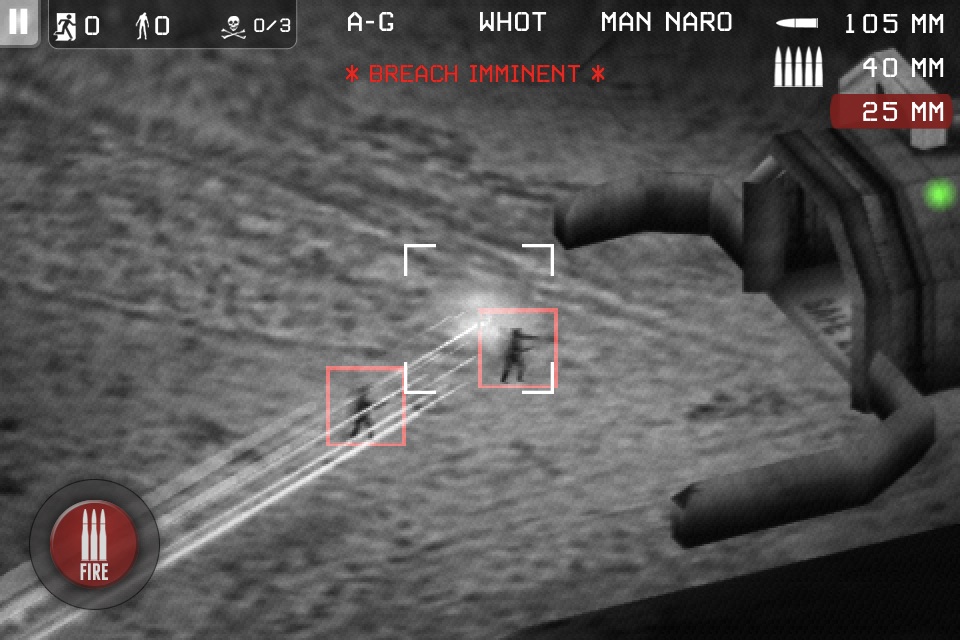
Zombie Gunship is an iOS game that puts you in an orbiting AC130 airplane equipped with mini guns, and two different kinds of cannons. In it, you are the gunnery captain whose task is to obliterate zombies marching on the entrance to a bunker complex. It’s night time, and the battle field is lit up in infrared. Uninfected humans light up the screen bright white, while the walking dead Zombies are a cold black heat sink on IR HUD. Your job is to kill the zombies, keep them from breaching the bunker entrance, but allow the humans through.
The Zombies, when not attacking the bunker, munch on the humans. The problem is that you are allowed to kill only 3 humans inadvertently before it game over -the commander orders you out of the airspace. It’s a simple game with no other characters or maps (a common complaint in the reviews) to mess things up. You gain credits for zombie kills and for each human who make it into the bunker, and you use these to upgrade the weaponry. You can also buy credits through the game (slick) so you can max out the specs on your three gun types (don’t ask me how much I’ve spent).
On an iPhone, the game is a portable addiction like a bag of jelly bellies. On the iPad, it’s engrossing and all consuming, like a really big bag of jelly bellies, and it is the way to play this game. The hook is this. You score better when you ignore the humans and just kill zombies, but then you see the poor blokes getting attacked by the zombies, albeit in tiny ant-sized distance on the infrared. You then are compelled to rescue them with a well gauged barrage from the mini gun, or a carefully distanced blast from the 40mm auto cannon. If you successfully kill the zombie and free the human, you get some points, and praise from the commander. You feel good about yourself in fact. In fact, you end up caring for the poor people running in the night for the shelter of the bunker and may get sidetracked into playing hero. Unfortunately, in this game, and as in all good Zombie movies, playing empathetic hero is not the best way to win at this game. The most efficient at clearing the approaches of zombies without killing yet not rescuing humans do best. There is no punishment for letting Zombie nature take its course.
A recent NYT article (http://www.nytimes.com/2011/08/07/books/review/the-state-of-zombie-literature-an-autopsy.html) pontificated about the Zombie phenomena, tying its popularity to the uncertainties of our times. I would add that Zombies have been with us before Romero created them as the basic fear of being consumed by anything that is not us -whether it is a great white shark, a Tyrannosaur, or an illegal immigrant.
Despite the fearsome images and terrifying drama of good Zombie films and literature, I find them a compelling and a great way to unwind and relax. A Zombie apocalypse, it turns out, does not necessarily favor the strongest or best armed. Rather, aside from a bit of luck, you need your wits. A Zombie armageddon is fair and meritocratic. A level playing field. And who doesn’t like that?

Japanese Beetles!

20110716-104409.jpg

My apple trees, azaleas, and rose bushes are infested with Japanese beetles. I went to my local garden center and the fellow there imparted information on how to get rid of these “vicious invaders” with such passion that I could picture him in camouflage imparting orders on killing the Japs invading the island. I am glad that nothing bad is named for Korea, but there are enough Asian named pestilences and diseases to leave me smiling wryly whenever I hear about these Japanese beetles, the bane of gardeners in the Midwest. The Asian Carp which in another time would have been the Chinese carp if we didn’t owe them so much money is another invasive pest that gets much scorn. I can only wonder what non-Asians think when they see more Asians on TV, at their golf courses, and in their families. I think we’re just part of a long tradition going back to the Spanish Flu, and the Black Death which was blamed on the Muslims. Harmless? Not really because it associates bad feelings with a locale or nationality.

Father’s Day Golf

Father’s Day passed with several fun things happening. First, I got to play guilt free golf in the morning, and I shot  an 84. Given the goal of playing par or better by Halloween 2012, I feel good about my progress. The secret sauce can be seen in the statistics from my Golfplan app.

In May, I was suffering from inconsistent play, and despite daily practice, was unable to make progress. Then I realized that trying to fix your own golf swing is a bit like removing your own gallbladder -something theoretically possible, but highly unlikely in practice. I sought professional help, and at Wakonda Club, we are fortunate to have Aaron Krueger who is a gifted instructor. Over two sessions, he was able to provide one critical principal that has changed my game. It is no surprise that it boils down to grip and stance, alignment and tempo.

It has been a revelation. This round occurred without my usual blow up holes, and I was surprised by the score at the end. And this has been no fluke -I have repeated it this past week and today, on a casual nine, I shot 46 despite a pair of double bogeys and a triple bogey. There is no question that professional instruction is the fastest way to improve.

That wonderful round on Father’s day was followed by swimming with the family and then a barbecue at home of L.A. Galbi, a Korean-American dish that I’ve always had in restaurants but never at home until I came across a recipe on Maangchi’s web site (link). It was clearly one of the best father’s day’s I’ve ever had.

The Perfect Game

Wakond Club No. 1, from blue tees, May, 2011

The perfect game in baseball is a rarity among rarities. Only a handful of no-hitters are seen in a season of baseball, but the perfect game of 27 consecutive outs and no base runners has been achieved only 18 times in baseballs modern era. In golf, the perfect game is all 18 holes played in par or better, and it is a seemingly reachable perfection. Like a dangling fruit just out of hand’s reach, par golf sits there printed on the score card. For the majority of golfers, it is as unattainable as pitching in the major leagues.

The quixotic and perverse nature of golf is that anyone with the means can play a round where a professional tournament is held (aside from uber private locales). And during that round, the average golfer may get a glimpse of perfection in the form of a par on a famous hole, a perfect sand blast to within a foot of the cup, or a chip that clatters against the pin and settles into the hole. These transcendent moments of golf perfection are gobsmack hits of opium for the golfer that brings the poor hack coming back for more. On the score card though, these bright spots of perfection are just holes in the roof letting in shafts of celestial light. I used to keep a golf log, and over the course of two years, my best scores on every hole on my home course resulted in a perfect 72. It was in me, but I suppose I never let it out.

Woe betide the golfer who yearns for more and tried to do something about it. I have finished reading the testimony of John Richardson,  who did such a thing and is the proselytizer of the perfect. His book, Dream On: One Hack Golfer’s Challenge to Break Par in One Year (link), is an engaging story that requires golfist faith -the faith that the honesty of the player is a given and that his tale is as true as a score card submitted for handicapping at the clubhouse. It is no big fish story, John’s tale.

I find a lot of things in common with John. We are of similar age growing up in areas where golf is part of the social mesh -me in North Florida, and John in Northern Ireland. I spent many years at the now defunct Baymeadows in Jacksonville, Florida, dreaming of playing with the best while struggling to break 90. Both of us admired Seve Ballesteros and his swashbuckling approach to the game. Both of us gave up golf to become working adults -me to go to college, medical school, and postgraduate training, John to work at becoming a successful  entrepreneur. And both of us took up golf again at similar points in life, after marrying and starting families.

What is different about John was that he took his obsession and channeled it into a deliberate path to perfection. At  the start, he struggled to break 100, but within a year, he broke par. While it was no surpise, the ending of the book in the kind of ethereal round of golf that all hackers dream of, the tension and drama were there nonetheless. The great thing about the book is not necessarily the end result, but the year long journey he took. John proved that all the well worn excuses that golfers have about themselves -including mine about not letting myself be scratch, are mistaken justifications for continued hacking. In fact, whenever he fell into a rut, it was revealed to him that it was a swing error, something as elemental as grip, posture, stance, and alignment, and not always his negative thoughts. That is correct -it’s not your negative thoughts, but instead bad form and lack of practice that leave your game rotting at bogey or worse.

He does seek professional help -and I have taken this advice by taking my first lesson with our amazing new club professional, Mr. Aaron Krueger. He also sought clinical motivational advice -not a shrink, but very close, because a golfing rapture is limned by golfing madness. And he practiced. A lot. Particularly his short game.

This is like one of those miracle baseball movies you can get where some average Joe all of a sudden is throwing heat in the big leagues. I read his book with the same suspension of disbelief that I have for big fish stories, with golfing faith. It gives me hope, and a renewed sense of purpose. So what does it all mean?

I will hereby publicly declare my intention to break par by the end of next season (October 31, 2012) and bring you along with me. May good golf come walking with me and endow my ball with angel wings.

Afghanistan’s Only Golf Course

From Evernote:

Afghanistan’s Only Golf Course

I came across this wonderful archive article in the New York Times about the only golf course in Afghanistan. I hope it is still open. It’s proprietor is clearly a golfist, and yearns for the day that will allow young Afghans to play golf in peace.
http://www.nytimes.com/2007/10/15/world/asia/15afghan.html