There are two seasons in a year, winter and golf. This past golf season just came to a close as the Wakonda Club and Des Moines Golf and Country Club covered their greens this past Monday. The season opened for me with cold rainy rounds at the Legacy GC where snow banks could still be seen in the rough. It took a miraculous 2 weeks to go from three feet of snow to lush green fairways and greens at Wakonda as the past three years’ investment in turf paid off. Despite the spring rains, the grounds crew somehow managed to groom the course into playable condition day after day. As the weather stabilized, the course blossomed in mid summer and Wakonda became a destination as it hosted multiple outings and events. What impressed me was how the course recovered after heavy usage. I credit this to favorable weather, knowledgeable members, and the grounds crew under Mr. Temme.
The weather mostly favored us in the latter summer and fall, creating a bumper crop of turf. The deep root systems, now several years old, allow for nearly instantaneous recovery if properly repaired. This is where the membership came through. Despite the unrepaired ball marks and unfilled divots after bouts of heavy play, the majority of members took it upon themselves to repair all the defects they came across and not just their own. Personal observation of the #10 green showed after an outing, the green had multiple unrepaired ball marks, which after a few days of play by membership and grooming by the grounds staff was basically tournament quality within several days. This was not possible in the older greens where heavily trafficked areas were susceptible to permanent damage requiring direct returfing.
This did nothing good for my handicap because the greens rolled very fast all season. At the Broadmoor for example, they were in the process of a yearlong grooming for the Ladies’ US Open next year, and this resulted in slower greens that I could hammer at –I shot an 86 there on the high course with no 3 putts, playing with three strangers who became good friends at the end. Wakonda gave no such quarter this year.
My favorite away-course this season? DMGCC –after many years, I am beginning to appreciate some of the lumpy bumps, and more importantly the friends I have to play a round with over there. This year included discovery of a no longer used set of Maruman irons in my dad’s garage. They are very light but launch the ball very high and long. Along with these came vintage Taylormade steel hybrids with the Raylor sole plate in 15 and 19 degrees. I have hit the 15 degree as far as my three wood on occasions but can land it with sore feet on long par threes. There really is no need to buy the latest and greatest but rather stick to what works. That said, my happiest moment came with my new set of Taylormade Burner irons, a birthday gift from my wife. I was 216 yards out on Wakonda #4 after fluffing the drive. After considering my choices, I had a great feeling about my 4 iron –I was on a slight downslope and there was wind at my back. I aimed left and set up for a smidge of fade. The pin was mid green to the left. I landed on the flat on the left of the fairway and the ball rolled on and came to a stop 2 feet from the cup. The shot of the year.
The grocery store turkey’s evolution from the wild turkey is an echo of our journey from our wilder, free-range origins. The wild turkey, whose intelligence caused Benjamin Franklin to recommend it for our national bird, is a far cousin of the overbred, overmedicated artifice that is the plastic wrapped bird that you plunk into your grocery cart. In the passage from our free-range origins to our over-cultivated existence, are we just overbred, overstuffed turkeys? Three things confirm this: the outsourcing of our basic food functions, the reduction of work into processes, and no reduction of stress from our surrender.
Outsourcing of Basic Food Functions
The wild turkey is known to be the most cunning of birds, requiring stealth and deceit to bring it close enough for a shot. I would assume the human in the original state of nature to be no different and no less intelligent. The urban legend is that the domesticated turkey is so stupid that they can’t be left out in the rain because they look up when hit on the head with raindrops, subsequently drowning. While this is untrue of domesticated turkeys, it may be true of domesticated humans, Homo sapiens sapiens familiaris.
We use to hunt for our food or gather it from the fields and forests. At a critical point, we domesticated the game and started farming the fruits and vegetables that sustained us, creating enough surplus calories to sustain larger populations that could then specialize in crafts, trades, and services, to where eventually the majority of the population could outsource food production to a minority of the people. If you’re lucky, you can buy a luscious apple out of season brought in by jet transport directly to your Costco from the Antipodes. This is not too much different from the turkey who willingly or unwillingly entered into the similar bargain with humans. In doing so, the turkey increased its population to an estimated 660 million turkeys currently in the world –technically a raging success on the chromosomal level. The outsourcing of the finding of food proved to be a Faustian bargain for the turkey whose life is rendered short and brutal. Depending on your outlook, the human bargain is no less Faustian because there are 6.8 billion humans, the majority of which now depend on this outsourced food production. If you are reading this on the internet, you are clearly benefiting from this arrangement. The recent economic downturn shows how easy it is to fall from the grace afforded by this system. If you can’t afford the fancy fruits, vegetables, and viands, you are stuck eating the processed corn and petroleum byproducts offered as stock feed for the masses.
Reduction of work into processes
Somewhere the idea of work, trade, and craft as virtuous activities became lost as the management professions became elevated. I remember having dinner right out of college with a bunch of young lawyers and consultants in Boston, none over the age of thirty. All were entrusted in some way with managing, valuing, judging, and giving advice on billions of dollars, thus affecting the lives of many people. None of these guys had really worked a day in their lives (including me except maybe stocking groceries throughout high school), but were clearly inside some kind of membrane that separated them from everyone else who did have to work for a wage and save a lifetime to afford a lifestyle that these young men were having straight out of college. One boasted that the yearly return on their fund outstripped the gross national product of whole countries, reaching for some kind of irony that I used to think was cool and now I think is depressing.
I have nothing against capitalism, and know second-hand through my parents and my wife’s parents the horrors of totalitarian communism, but there is a problem when theory trumps practice. Business management allows the reduction of any human activity into processes. The inputs and outputs of these processes can be tabulated, analyzed, and optimized. The logical end result is a human worker confinement pen like the factories in Shenzhen that make my gadgets –the workers live in dormitories adjacent to the factories allowing them to run 24/7. What we are witnessing is the ongoing triumph of totalitarian capitalism, and we’re going to either compete with China on their level or borrow furiously to maintain our relatively luxurious, free-range confinement pens. Neither is palatable to a country having just ended America’s Century in the dust cloud of falling towers.
No Reduction of Stress From Our Surrender
The majority of us don’t worry about food because it’s always there in the mega-mart, piled high and cheap. By surrendering our food production, we give up a load of stress but gain new ones. The ancestral stresses of hunger, climate, fear, and disease have been swapped for financial, social, and domestic stress. We outsourced our security functions to the local constabulary and our military, but rather than bask in security, we worry about terrorists at home and an endless war abroad. This stress is basically the same stress that the Thanksgiving turkey feels confined to a few square feet among thousands of other turkeys. That turkey fears not the fox, coyote, or bear, but it must feel something is terribly wrong with its world.
Taking It Back
The populist anti-elitism that elevated the dancing Palin against far more qualified, limber, and graceful competitors bears poorly for America’s continued excellence. The problem is not with the elites, but with the complicity of the turkeys in their continued confinement. Rather than cheap corn and petroleum based feed, they should demand the variety of diet that was available only two generations ago right out of small family farms and home vegetable gardens. Rather than dismiss food reform as the socialist dalliance of elitists, people should confront the source of their predicament.
The second half of this is the realization that the solution to outsourcing is In-Sourcing –which means work. It means that the service industry jobs that move quants and utils over the intertubes must be abandoned for work, trade, and craft. It means taking it down a notch as a society and lowering expectations while elevating living. It means a lot more people working in food production and repopulating small towns. It means reconnecting with community and family rather than moving every three years from Charlotte to Atlanta to Houston to Tampa to Denver. It means sweeping, hoeing, weeding, hunting, fishing, gathering.
Worse catastrophes have happened to people –go ask the Carthaginians when you’re in line in purgatory. People want a return to the past, to the golden age of the 50’s and early 60’s. What we’ll get is the 1920’s and 30’s. If you aren’t Howard Hughes, it’ll be a lot of work after work, with canning in the fall.
I have always wanted to directly access my Outlook schedule on my Macbook Pro, and found nothing that really satisfied except to go into Virtual Box, run Windows and launch Outlook. I purchased Office 2011 for Mac really just for the Outlook, but found to my disappointment, that it supports only Exchange Server 2007 or later. Our corporate server is Exchange Server 2003, and so I’ve had zero luck trying to get it to work.
I was on the cusp of returning the package to the Apple store when I launched Word just for the hell of it. Yes, there are some Microsoft related annoyances like the listed user on the splash screen is “Test User” rather than me, and I can’t figure out how to change that, but despite that, I have come to love Word 2011, even more than Pages.
I never really warmed to Pages despite its relatively straightforward and simplified scheme. It does create beautiful PDF documents and I think that that is how I will use Pages.
What I love about this Word is that it is Word, and for some reason, I don’t mind the business at the top -called the Ribbon. It’s remarkably easy to use.
My corporate experience with Word 2003 is not so great, but mostly tolerable, but 2011’s Word is just flat out wonderful. I haven’t even started using the cloud links. Fact is, I hated going to Google apps except to bang out snippets to paste into a later document. Same goes for using Pages on my iPad, which I have decided is not to be used with a keyboard unless absolutely necessary -the Bluetooth never really works and requires frequent re-linking, and even with the plug in keyboard stand (pictured partially under the Office 2011 box above), it never really works well.
Why is Word 2011 all of a sudden important to me?
First, my Macbook Pro is back. I basically stopped using it over the summer because of iPad, but I realize now that to make stuff, you still need the power of a laptop. I toyed with the idea of getting a Macbook Air, but the primary thing that I wanted was just battery life, and I could get it with extra batteries. When the warranty runs out, I plan on swapping the hard drive out for Flash based SSD’s.
The Macbook Pro, despite being 2 years old, is still lightning fast and eminently sufficient for what I need to do. Docked here to a 23 inch monitor, it basically functions as an iMac, but mobile, it is wonderful to sit down in a comfortable chair and compose.
Second, writing well is very important to me and I have always chosen the finest papers and writing instruments when I write manually (and lose a lot of those fine writing instruments, which is why I favor multipacks of Uniball Onyx pens). Word 2011 is like a top of the line IBM Selectric or a Mont Blanc pen. With 2011, you are writing in style. The spell checking, the formatting, the grammar checking all works well and intuitively. For example, I chose the quotation format, and then later changed the font. It asks you subsequently when you make another quotation, if you want to use the modified format, but does so in a way that doesn’t infuriate you like past Microsoft efforts.
Third, compatibility is still an issue. Despite the fact that I find quitting desktop based software for the cloud easy and natural, most people don’t. There will necessarily be a five year time lag before it ever happens and it may never really happen as people don’t want Google or Facebook (cloud apps are next for them) to know everything about you. The funny thing is, the default file format is .docx which is not backwards compatible!
Fourth -there is no Clippy. In fact, there is very little Windows anything. It feels like Mac software, which OpenOffice and StarOffice, the free office suites, do not. Pages feels more like a page layout software than a word processor, while the iPad version’s fixed appearance just drives me crazy -call me shallow but I think the fake wood top margin drives me insane, and I have gravitated to Quickoffice on iPad for exactly that reason.
After the long car ride from Miami to Orlando, we dropped in on a Korean restaurant where I ordered Woogujiguk. It is a mildly spicy cabbage and beef stew which is comforting and filling. There is a restaurant on the second level at Incheon International Airport where this dish is featured. It’s cheap (about 8 bucks) and delicious and served within minutes of ordering. The cabbage is soft and the beef is tender from hours of boiling. Its usually the last thing I eat on leaving Korea and for whatever reason, something I only eat on the road. Tasting it brings to mind journeying and cold weather.
If you are a citizen and you are of voting age, then it is your duty to vote. You have no basis for complaint if you do not vote. Many people around the world risk their lives to vote. Many people risked and given up their lives and are giving up their lives as we speak so that you can vote even from the comfort of your home.
There is no longer any excuse not to vote with early and absentee voting. God bless America.
The hole is 178 yards long from the blues, slightly downhill and depending on the prevailing winds needs anything from a 7 iron to 3 hybrid. It’s an easy 3 if you just let the clubs do their work, but try to muscle this hole, a 5 or worse awaits.
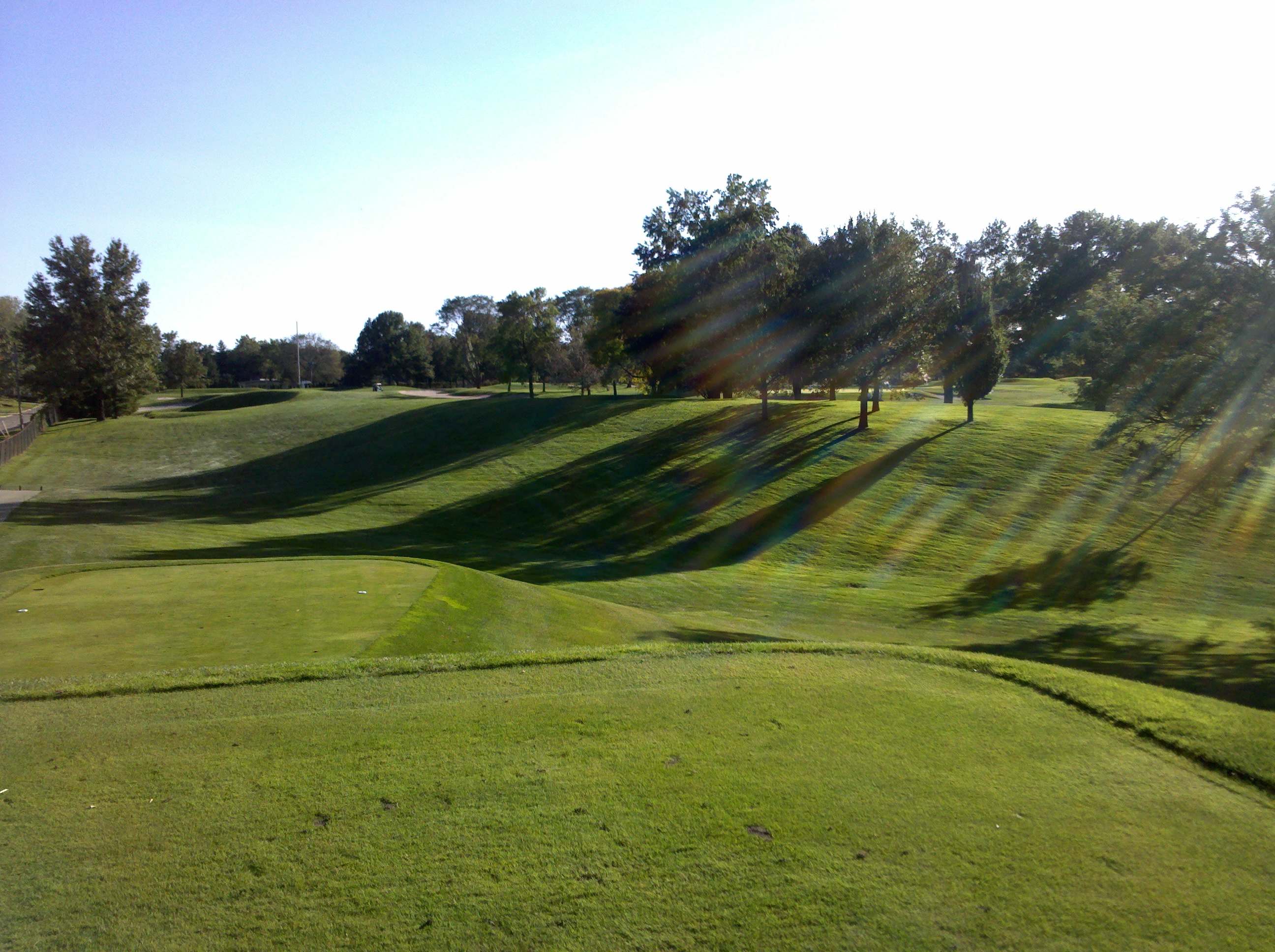
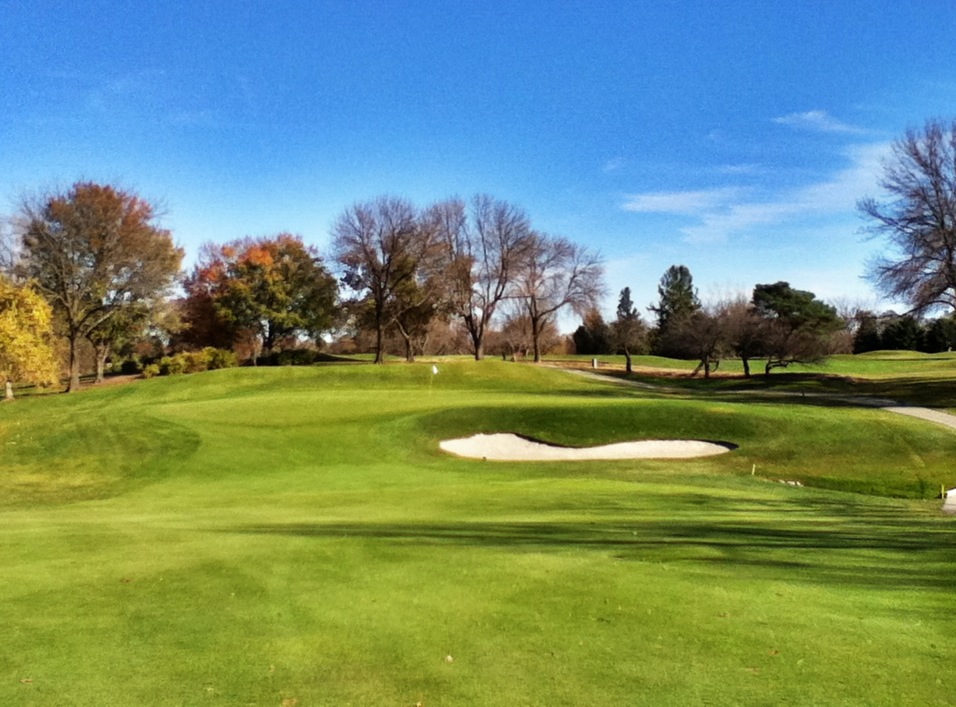 –after many years, I am beginning to appreciate some of the lumpy bumps, and more importantly the friends I have to play a round with over there. This year included discovery of a no longer used set of Maruman irons in my dad’s garage. They are very light but launch the ball very high and long. Along with these came vintage Taylormade steel hybrids with the Raylor sole plate in 15 and 19 degrees. I have hit the 15 degree as far as my three wood on occasions but can land it with sore feet on long par threes. There really is no need to buy the latest and greatest but rather stick to what works. That said, my happiest moment came with my new set of Taylormade Burner irons, a birthday gift from my wife. I was 216 yards out on Wakonda #4 after fluffing the drive. After considering my choices, I had a great feeling about my 4 iron –I was on a slight downslope and there was wind at my back. I aimed left and set up for a smidge of fade. The pin was mid green to the left. I landed on the flat on the left of the fairway and the ball rolled on and came to a stop 2 feet from the cup. The shot of the year.


 Golfism -life is a metaphor for golf