Zombie Gunship -a review, and an explanation of why Zombie things relax me

Zombies are definitely putting their stamp on the zeitgeist. Until recently, vampires were all the rage, but they were never my cup of tea. While vampires are about forbidden seduction -think Don Draper and your mom (didn’t know he was a vampire, did you?). The thing that people don’t get about Zombie movies and fiction is that the Zombies aren’t really the center of the action. This was illustrated in one of the finest Zombie movies to date, The Road (didn’t know it was a Zombie movie, did you?). Zombies are the Gom Jabbar of a Humanity Test (didn’t think I’d reference Dune, did you?). Like a round of golf, a person’s response to a Zombie apocalypse is all about character.

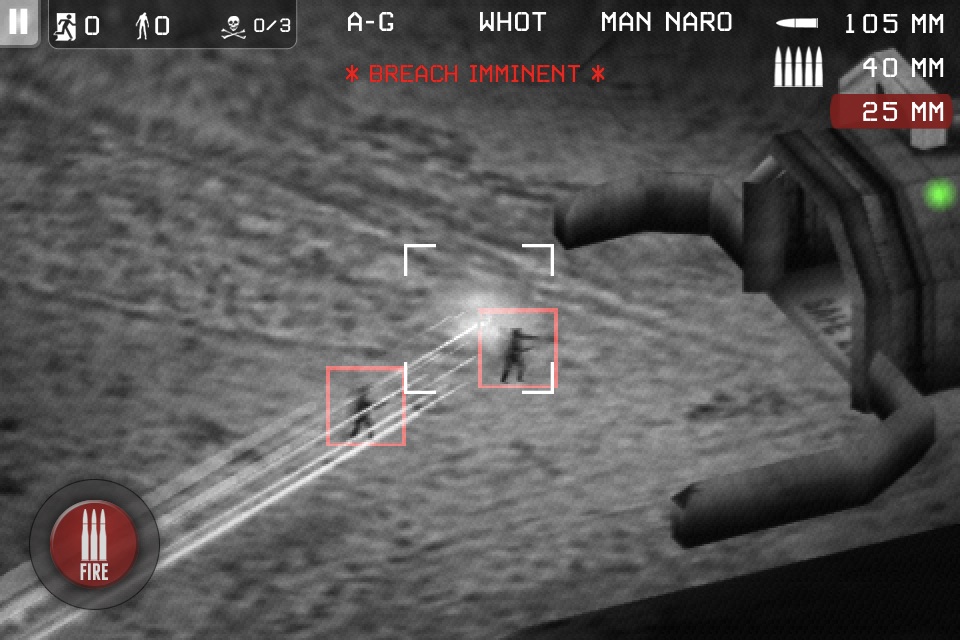
Zombie Gunship is an iOS game that puts you in an orbiting AC130 airplane equipped with mini guns, and two different kinds of cannons. In it, you are the gunnery captain whose task is to obliterate zombies marching on the entrance to a bunker complex. It’s night time, and the battle field is lit up in infrared. Uninfected humans light up the screen bright white, while the walking dead Zombies are a cold black heat sink on IR HUD. Your job is to kill the zombies, keep them from breaching the bunker entrance, but allow the humans through.
The Zombies, when not attacking the bunker, munch on the humans. The problem is that you are allowed to kill only 3 humans inadvertently before it game over -the commander orders you out of the airspace. It’s a simple game with no other characters or maps (a common complaint in the reviews) to mess things up. You gain credits for zombie kills and for each human who make it into the bunker, and you use these to upgrade the weaponry. You can also buy credits through the game (slick) so you can max out the specs on your three gun types (don’t ask me how much I’ve spent).
On an iPhone, the game is a portable addiction like a bag of jelly bellies. On the iPad, it’s engrossing and all consuming, like a really big bag of jelly bellies, and it is the way to play this game. The hook is this. You score better when you ignore the humans and just kill zombies, but then you see the poor blokes getting attacked by the zombies, albeit in tiny ant-sized distance on the infrared. You then are compelled to rescue them with a well gauged barrage from the mini gun, or a carefully distanced blast from the 40mm auto cannon. If you successfully kill the zombie and free the human, you get some points, and praise from the commander. You feel good about yourself in fact. In fact, you end up caring for the poor people running in the night for the shelter of the bunker and may get sidetracked into playing hero. Unfortunately, in this game, and as in all good Zombie movies, playing empathetic hero is not the best way to win at this game. The most efficient at clearing the approaches of zombies without killing yet not rescuing humans do best. There is no punishment for letting Zombie nature take its course.
A recent NYT article (http://www.nytimes.com/2011/08/07/books/review/the-state-of-zombie-literature-an-autopsy.html) pontificated about the Zombie phenomena, tying its popularity to the uncertainties of our times. I would add that Zombies have been with us before Romero created them as the basic fear of being consumed by anything that is not us -whether it is a great white shark, a Tyrannosaur, or an illegal immigrant.
Despite the fearsome images and terrifying drama of good Zombie films and literature, I find them a compelling and a great way to unwind and relax. A Zombie apocalypse, it turns out, does not necessarily favor the strongest or best armed. Rather, aside from a bit of luck, you need your wits. A Zombie armageddon is fair and meritocratic. A level playing field. And who doesn’t like that?

Japanese Beetles!

20110716-104409.jpg

My apple trees, azaleas, and rose bushes are infested with Japanese beetles. I went to my local garden center and the fellow there imparted information on how to get rid of these “vicious invaders” with such passion that I could picture him in camouflage imparting orders on killing the Japs invading the island. I am glad that nothing bad is named for Korea, but there are enough Asian named pestilences and diseases to leave me smiling wryly whenever I hear about these Japanese beetles, the bane of gardeners in the Midwest. The Asian Carp which in another time would have been the Chinese carp if we didn’t owe them so much money is another invasive pest that gets much scorn. I can only wonder what non-Asians think when they see more Asians on TV, at their golf courses, and in their families. I think we’re just part of a long tradition going back to the Spanish Flu, and the Black Death which was blamed on the Muslims. Harmless? Not really because it associates bad feelings with a locale or nationality.

Father’s Day Golf

Father’s Day passed with several fun things happening. First, I got to play guilt free golf in the morning, and I shot  an 84. Given the goal of playing par or better by Halloween 2012, I feel good about my progress. The secret sauce can be seen in the statistics from my Golfplan app.

In May, I was suffering from inconsistent play, and despite daily practice, was unable to make progress. Then I realized that trying to fix your own golf swing is a bit like removing your own gallbladder -something theoretically possible, but highly unlikely in practice. I sought professional help, and at Wakonda Club, we are fortunate to have Aaron Krueger who is a gifted instructor. Over two sessions, he was able to provide one critical principal that has changed my game. It is no surprise that it boils down to grip and stance, alignment and tempo.

It has been a revelation. This round occurred without my usual blow up holes, and I was surprised by the score at the end. And this has been no fluke -I have repeated it this past week and today, on a casual nine, I shot 46 despite a pair of double bogeys and a triple bogey. There is no question that professional instruction is the fastest way to improve.

That wonderful round on Father’s day was followed by swimming with the family and then a barbecue at home of L.A. Galbi, a Korean-American dish that I’ve always had in restaurants but never at home until I came across a recipe on Maangchi’s web site (link). It was clearly one of the best father’s day’s I’ve ever had.

The Perfect Game

Wakond Club No. 1, from blue tees, May, 2011

The perfect game in baseball is a rarity among rarities. Only a handful of no-hitters are seen in a season of baseball, but the perfect game of 27 consecutive outs and no base runners has been achieved only 18 times in baseballs modern era. In golf, the perfect game is all 18 holes played in par or better, and it is a seemingly reachable perfection. Like a dangling fruit just out of hand’s reach, par golf sits there printed on the score card. For the majority of golfers, it is as unattainable as pitching in the major leagues.

The quixotic and perverse nature of golf is that anyone with the means can play a round where a professional tournament is held (aside from uber private locales). And during that round, the average golfer may get a glimpse of perfection in the form of a par on a famous hole, a perfect sand blast to within a foot of the cup, or a chip that clatters against the pin and settles into the hole. These transcendent moments of golf perfection are gobsmack hits of opium for the golfer that brings the poor hack coming back for more. On the score card though, these bright spots of perfection are just holes in the roof letting in shafts of celestial light. I used to keep a golf log, and over the course of two years, my best scores on every hole on my home course resulted in a perfect 72. It was in me, but I suppose I never let it out.

Woe betide the golfer who yearns for more and tried to do something about it. I have finished reading the testimony of John Richardson,  who did such a thing and is the proselytizer of the perfect. His book, Dream On: One Hack Golfer’s Challenge to Break Par in One Year (link), is an engaging story that requires golfist faith -the faith that the honesty of the player is a given and that his tale is as true as a score card submitted for handicapping at the clubhouse. It is no big fish story, John’s tale.

I find a lot of things in common with John. We are of similar age growing up in areas where golf is part of the social mesh -me in North Florida, and John in Northern Ireland. I spent many years at the now defunct Baymeadows in Jacksonville, Florida, dreaming of playing with the best while struggling to break 90. Both of us admired Seve Ballesteros and his swashbuckling approach to the game. Both of us gave up golf to become working adults -me to go to college, medical school, and postgraduate training, John to work at becoming a successful  entrepreneur. And both of us took up golf again at similar points in life, after marrying and starting families.

What is different about John was that he took his obsession and channeled it into a deliberate path to perfection. At  the start, he struggled to break 100, but within a year, he broke par. While it was no surpise, the ending of the book in the kind of ethereal round of golf that all hackers dream of, the tension and drama were there nonetheless. The great thing about the book is not necessarily the end result, but the year long journey he took. John proved that all the well worn excuses that golfers have about themselves -including mine about not letting myself be scratch, are mistaken justifications for continued hacking. In fact, whenever he fell into a rut, it was revealed to him that it was a swing error, something as elemental as grip, posture, stance, and alignment, and not always his negative thoughts. That is correct -it’s not your negative thoughts, but instead bad form and lack of practice that leave your game rotting at bogey or worse.

He does seek professional help -and I have taken this advice by taking my first lesson with our amazing new club professional, Mr. Aaron Krueger. He also sought clinical motivational advice -not a shrink, but very close, because a golfing rapture is limned by golfing madness. And he practiced. A lot. Particularly his short game.

This is like one of those miracle baseball movies you can get where some average Joe all of a sudden is throwing heat in the big leagues. I read his book with the same suspension of disbelief that I have for big fish stories, with golfing faith. It gives me hope, and a renewed sense of purpose. So what does it all mean?

I will hereby publicly declare my intention to break par by the end of next season (October 31, 2012) and bring you along with me. May good golf come walking with me and endow my ball with angel wings.

Afghanistan’s Only Golf Course

From Evernote:

Afghanistan’s Only Golf Course

I came across this wonderful archive article in the New York Times about the only golf course in Afghanistan. I hope it is still open. It’s proprietor is clearly a golfist, and yearns for the day that will allow young Afghans to play golf in peace.
http://www.nytimes.com/2007/10/15/world/asia/15afghan.html

World’s Longest Par 3

http://breakparblueprint.com/blog/339/seven-great-secrets-i-learnt-from-seve-ballesteros/

This is a link to John Richardson’s breakparblueprint site. On the page is a fun video of John attempting to birdie a longest and possibly scariest par 3 on the planet. You need to helicopter to the tee box and the drop is beyond scary. It reminds me of this par 4 in Maui that featured a 400 foot elevation drop to a green 400 yards out. I drove the green but three putted.

Extreme Golf

I took tax day off and played a round during an ice storm. Good for building character, playing in inclement weather is useful in testing your game against many more variables than just the usual yardage, light wind, lie, elevation, incline, etc. Add to it slickness of grip, 35mph prevailing winds, stinging rain and sleet, and hypothermia and you have a sport -Extreme Golf.

Golfshot- Golf GPS and Golfplan -a belated review

20110327-023451.jpg

Wakonda #2 from the tee

20110327-023515.jpg

The distance from the tee to mid green with about 20 feet of elevation -an 8 iron

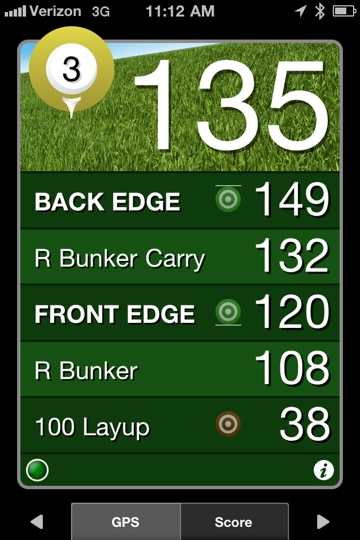
Several years ago, after I got my first iPhone, among the first and most useful programs was View Ti Golf, which I reviewed a while back. It was after several overly confusing updates and broken functionality, that I stopped using View Ti, and moved to Golfshot GPS.

While I had meant to review Golfshot GPS, I was too busy actually using it to put a good review together -I did comment on it a couple of years ago, but it is the addition of analytics and instruction from Paul Azinger via Golfplan that make this sing.

20110327-023535.jpg

20110327-023543.jpg

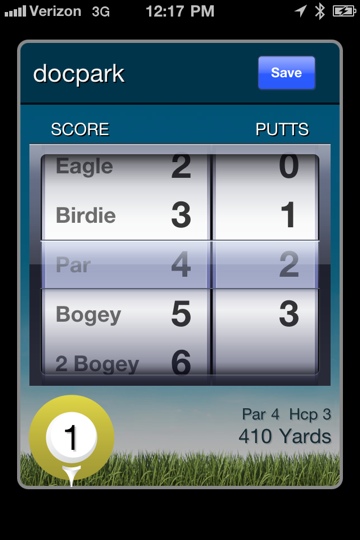
What they achieved is they’ve simplified the geekiest part of tracking statistics. The simplest method has always been keeping track of Fairways, GIR, Strokes from 150 yards, and Putts on a score card. Golfshot has made it even simpler by making the input of strokes, fairways, and putts, along with sand and penalty strokes mere flips of menu dials.

20110327-023554.jpg

You can use the program solely for getting distances on all the golf courses in the US (and supposedly the planet). This will cost you 29.99. There is a lite version for free which offers scoring and the analytics. To tell you the truth, the GPS is nice, but I try to set up my shots with sight and local knowledge -its the statistics which make it worth using this program.

All the data is stored in the cloud and so you can use this app on multiple devices even on a GPS-less ipod touch or Wifi-iPad. The program works very well on Android as well (though readers of this blog know my feelings about Android).

The scorecard shows the parts of the game that I have to concentrate on -GIR -meaning my mid irons to pitching wedge, and sand -avoiding them and getting out of them.

20110327-023605.jpg
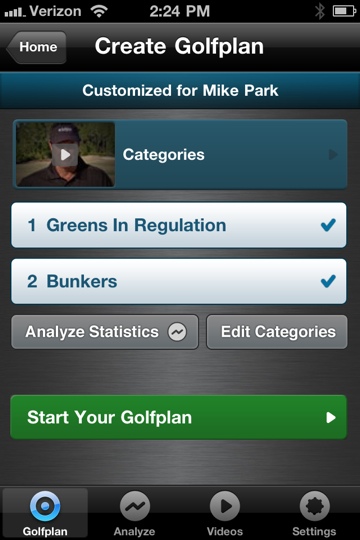
The complementary half of this is Golfplan which is currently at a promotional price of 0.99. Mr. Azinger is a great communicator and passes along in 1 to 2 minute videos perfectly executable knowledge to the average golfer. I think the best results can be had for the advanced beginner to 10 handicapper and this appears to be the target audience.

The stats are analyzed and a customized lesson plan is created for drills and instructions. Given the cost of private golf lessons, this is beyond cheap at just under a buck.
The problem with golf instruction is that most golfers take a band aid approach to lessons -thinking one or two lessons to straighten out the ball is enough.

20110327-023612.jpg

That’s like going to the doctor once to start treatment for a serious condition and then treating it yourself. Finding a good professional isn’t hard -every golf course has a PGA professional dedicated to improving play. It’s committing to a series of lessons over years that is tough -in terms of time and cash.
Gofshot GPS and Golfplan both get 4.5 stars on the App store which is basically a perfect score. I agree and outside of signing on with a golf instructor for a year’s worth of weekly lessons, this is the best thing since sliced cheese. I will update everyone on my progress.

Sent from my iPad