The Unconnected

20111108-123638.jpg

I recently saw advertisement for a 16gB flash drive for $8 and I smiled as I thought about how cheap memory had gotten compared to twelve years ago when I bought a 32mB flash drive for $200. It is a nice benefit of Moore’s law, but it also brought a slight shudder as I thought about its provenance. Several years ago, there was a rash of malware transmitted from flash memory embedded in digital picture frames. It was a ham-handed attempt at infecting computers world wide, but it made me concerned that most of our technology comes from China. It also gave me the idea of maintaining an unconnected computer, one that requires no internet connection and would serve as a repository of important information and private thoughts.

The Chinese understand this issue as a national security one, and recently announced the creation of its first homegrown supercomputer. Less noticed was the fact that all the processors were custom silicon using custom instruction sets -without knowledge of these instructions, it would be devilishly hard to create programs to enter, monitor, and transmit information. It is the ultimate in unconnected computer and its appearance should be as dismaying as finding a black monolith pulsating with data in the Serengeti. With custom silicon and architecture and an unknown operating system -likely a custom written and compiled Unix, this computer stands apart.

My son’s favorite show is Star Wars Clone Wars. The loyal and brave clones in this series are doomed because ultimately, they are designed to betray their Jedi masters when they are most vulnerable. The Sith Lord enacts Order 66, which causes the Clones to turn on their Jedi leaders. It makes me wonder, how much of the processing power in government and military hardware is sourced from China, and if our insistence on transparency, openness, and interconnectedness is an exposed Achilles heel. Is my iPhone really mine, or does it serve several competing masters? Will our next Pearl Harbor or 9/11 be all the electricity and cell service turning off with planes and satellites crashing and my Facebook telling me to go quickly to the place where the planes and satellites will be crashing?

The only way to really know your computer is secure is to make your own computer using chips and circuitry of known provenance. For example, if you created a parallel array of G4 processors made in California with graphics processors made in California, and running an OS that you can inspect line by line and compile yourself, you might be safe. Going further, you can go completely off the grid and eschew technology and society, keeping your own counsel and recording your thoughts in Moleskine notebooks with pencils stolen from golf courses.

Plausible? Of course not. What China has done is create the equivalent structure of a walled city in its completely home-brewed computer. It sends a message and how you interpret it is up to you.

Intersection of Healing and Technology

So much has been written in the short time since Steve Job’s death, that I will refrain from expressing my personal grief at his passing. I just finished his biography by Walter Isaacson. I read between cases and into the night. The most recent memory I have of Steve (he is now all of ours to refer to personally) is watching his introduction of the iPad2, which I watched on-line this past spring. The final image was what stuck with me –the intersection of the liberal arts and technology. That is why Apple products are so wonderful –they liberate the individual to perform insanely great things with computers that were frankly difficult or impossible before. It has also inspired me to think about health care’s relationship to technology.

Modern health care is about delivering technology. I can now repair an abdominal aortic aneurysm with stent grafts delivered via two small incisions smaller than the width of my pinky where traditionally, I had to make a long incision on the belly. These patients go home the next day. Small computers embedded in pacemakers can sense arrhythmias, correct them, and send reports to physicians by internet. Drugs can be tailored to the genetic makeup of tumors. You can have your genome scanned for disease risk.

But in the practice, on the back end, health care is very analog, very dependent on paper and pen, dictation, and text. The best medical notes read like compelling tone poems but can only be composed by direct speech or penmanship. The notes generated with the assistance of computers end up formatted for other computers and insurance companies. I generally skip to the human generated summary section and plan of care, yet even here, most EMRs (electronic medical records) try to parse meaning by stuffing what is analog into digital cubbies. Electronic medical records are ripe for reimagining.

When I want to know the temperature in Orlando, where my father lives, I can ask my smartphone, “What is the weather in Orlando, Florida?” and the temperature pops up along with weather forecast for today, this week, and so on. My email, my contacts, my friends are instantly available. When it comes to my patients, it is an entirely different story.

The problem is that hospital information services serve many needs and therefore devolve into the least common denominator in order to be used in an infinite variety of scenarios. Often, during the course of decades, legacy systems and databases serving different aspects of patient care create an alphabet soup of programs, each with their own security needs and access methods.

For example, in most hospitals, to look up blood tests, you have to log into the computer, then log into several layers of programs then look up the patient, select the correct admission, then select the laboratories -all the while remembering multiple long and complex passwords which you are not allowed to write down. You repeat the process to look up x-ray images, and chart notes from other physicians if they happened to have been scanned in. I can find out the location of every Starbucks in Manhattan and have them mapped out, but checking patient information is a trip back to 1985 in terms of technology. On top of all of this, hospital computer programs are simply ugly. Steve would not approve.

Steve’s philosophy of vertical integration -of creating the software, hardware, store, and services, created simplicity for the end user. It made the technology work magic by being carefully thought out from top to bottom. Simple takes a great deal of effort, but the returns are clear. What a great day it would be if I could just ask my smartphone, “What is Mrs. Smith’s potassium over the past week?” and get an answer.

The answer, of course, is to begin the work needed to get to that point. And that is the great lesson in Steve Job’s life -not fortune, nor influence, but that beautiful simplicity takes a great deal of focus and effort. Thank you Steve for showing us how.

Adonit Keyboard for iPad 2 -a review

20110821-044729.jpg

I just got the Adonit keyboard for the iPad 2, and I can’t overstate how great it is. I kept the iPad 2 with its original magnetic cover, but found that it offered no protection against drops and when vertically inclined, was not stable enough to work well with the Apple bluetooth keyboard -it would tip over when I poked at the screen.

The case adds bulk to the iPad 2, but adds up being not much bulkier that the original iPad within the stock Apple case. Plus, there is the “quick release” feature that easily frees the iPad for regular tablet use. The bluetooth is completely unobtrusive after pairing -something that I found annoyingly dodgy with other bluetooth keyboards including the Palm bluetooth keyboard, a cheaply made bluetooth thumb keyboard, and even Apple’s own bluetooth keyboard.

The keys are small -this gives it portability, but many with big fingers won’t like this keyboard. If you could touch type on the Psion series 5, then you can use this keyboard. The only hassle is the right sided shift key which is small and right next to the up arrow key resulting in annoying cursor shifts during text entry -but I’m getting used to us. The keys carry and click nicely giving feedback, which a lot of silicone covered keys found on at Brookstone and in airport gadget shops don’t do well.

The keyboard uses 3 AAA batteries. I do have to complain about the on/off switch. There is no way to tell aside from memorizing, what position is on or off.

What does this setup accomplish? My Macbook Air does not need to come with me on long trips as I am able to accomplish 95% of all my tasks on the iPad 2. This was not as handy when I carried a separate Apple bluetooth keyboard.

iCloud Glitch!

I’ve been purchasing music from the iTunes store under a single account from way back when, and was excited by the iCloud’s feature allowing me to download purchased tracks on my various iDevices and Mac’s. Unfortunately, when I attempt to do so with tracks purchased prior to this year, iCloud does not recognize the purchase under the account and does not let me download, even though the track shows up in the “purchased” tab on iTunes on my Macs and on my iPods/iPads/iPhones. The support people must be referring to the purchase history seen by iCloud because they claim I did not purchase these tracks when clearly I own them, have them on some devices, and they come up on the “purchased” section of iTunes!


Would like to know if anyone else has seen this.

Golfplan -in app upgrade available tomorrow

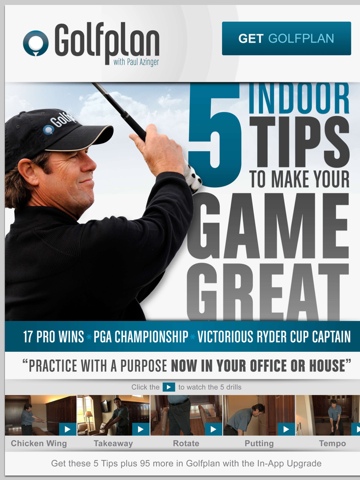
20110420-144803.jpgPress release for Golfplan -will have indoor golf drills to hone your game from the inimitable and formidable Mr. Paul Azinger.

SHOTZOOM AND GOLF PRO PAUL AZINGER HELP GOLFERS ACE THEIR GAME

Golfplan with Paul Azinger in-app purchase includes 28 new indoor instructional videos to help amateurs practice their game at home or in the office; Integrates with Golfshot, the world’s largest and most active online golf community

Phoenix, Ariz. – April 21, 2011 – Shotzoom® (www.shotzoom.com), the leader in active lifestyle mobile applications, and Paul Azinger, PGA Pro and victorious Ryder Cup Captain, today announced an in-app purchase to Golfplan with Paul Azinger, the best-selling golf instructional app in the world. Available for the iPhone, iPod touch and iPad, the updated app now includes 28 new instructional videos by Azinger to help amateur golfers practice at home or in the office. G

olfplan integrates with the world’s largest active golf community, Golfshot.com, where members share, compare and chart their golf game statistics, generate customized training plans and receive detailed insight into their performance over time.

20110420-144813.jpg

“I’ve spent thirty years touring and most golfers don’t have a good caddie, statistical charting and expert coaching,” said Azinger. “Golfplan, along with stats kept from Golfshot GPS, offers personalized tips, coaching and drills golfers need to take their game to the next level. And with this update, not getting to the course isn’t an excuse to not practice – rain or shine, anyone can practice with a purpose from their home or office with this app.”

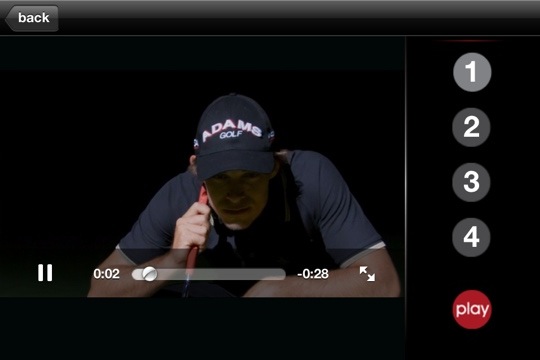
Amongst the 28 new tutorial videos, Azinger demonstrates proper swing path, ways to create lag and proper weight transfer drills. Based on the user’s handicap and Golfshot statistics, Golfplan provides personalized instruction plans to help every golfer improve their game – from shaving strokes off their short game to adding a few extra yards to their tee shot.

“Our apps provide instruction as well as performance statistics that let members track their progress over time and compare results with others,” said Craig Prichard, president of Shotzoom. “The integration with our Golfshot community brings members into a network of highly engaged users with similar interests.”

Features of Golfplan with Paul Azinger include:

– Instructional videos for categories including driving, greens in regulation, short game, bunkers and putting
– Statistics that identify strengths and weaknesses
– Ability to see and track progress over time
– Sharing and feedback tools tied to community members
– Exclusive instruction from Paul Azinger

Golfplan with Paul Azinger integrates with Shotzoom’s Golfshot community, the world’s largest active golf community with more than a half-million active members. Through Golfshot’s suite of products, members have the ability to score and store rounds, gain insight into their game performance, track improvement, share their statistics and compare with community members. Members have played over 50 million holes of golf on 37,000 courses in 152 countries in the 19 months since Golfshot: Golf GPS launched.

Golfplan with Paul Azinger is available for $0.99 in the App Store (www.itunes.com/appstore) for iPhone, iPod touch and iPad. The in-app purchase that includes tips and drills for the home and office is available for $1.99.

About Shotzoom
Shotzoom, LLC creates market leading mobile experiences that empower active lifestyles and enhance the fun of sports and fitness. Its mobile apps integrate with its online participation platform, where people with active lifestyles can track their performance over time, share with friends and interact with members who have similar interests. Shotzoom’s apps include the newly released Tiger Woods: My Swing, the best-selling and top grossing golf GPS app worldwide, Golfshot: Golf GPS, the best-selling golf instructional app worldwide, Golfplan with Paul Azinger, and the most downloaded universal instructional baseball app, Baseball Gameplan with Jason Giambi.

Seeitgolf- a review

With the advent of Spring and the new golf season, I sat down to figure out the barriers to shooting in the 70’s. All the tools are there: swing, equipment, course, and golf stretching back to my early teens. The biggest impediment, I decided, was my short game and putting. The stats (from Golfshot GPS) don’t lie.

Hearing the ball drop into the cup brings on a Pavlovian reaction...

I came across Seeitgolf while downloading the Masters app. It seemed silly at first, watching what amounts to golf porn, with money shot after money shot, but if you put yourself into the correct frame of mind, the imagery and sound of success becomes ingrained.

My first foray after immersing myself in Seeitgolf was typical with usual mix of two and three putts but subsequently on the back nine, I went one under over the last six holes after double and triple bogey to start. I drained 35 footer with seven feet of break uphill for birdie and followed up with an assortment of crazy one and two putts. It seemed natural and I lost the dread of landing my approach off the green -chip on and drain that ten footer.

The app is not entirely intuitive as it seems to have been composed on Flash or some other machination designed to ease app composition. It behaves more like a web site at times.

That said, drilling your mind, which the app says cannot tell between the imagined and the real, has it’s benefits. I strongly recommend this app for people who understand the mental dimensions of the game and can sit through about a half hour of meditative focus.

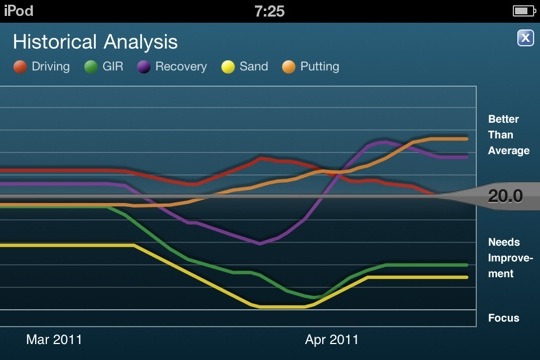
Putting (in orange) has improved since downloading Seeitgolf App

The statistics from Golfshot app shows my putting performance to have improved into the above average zone (orange line above) since getting Seeitgolf around the time of the Masters. It really works. If they could only add the ability to turn the ball dropping in the hole sound to an alert sound for the iPhone…

Extreme Golf

I took tax day off and played a round during an ice storm. Good for building character, playing in inclement weather is useful in testing your game against many more variables than just the usual yardage, light wind, lie, elevation, incline, etc. Add to it slickness of grip, 35mph prevailing winds, stinging rain and sleet, and hypothermia and you have a sport -Extreme Golf.

Contest for Tiger Woods Memorabilia

disclaimer -I am in no way affiliated with Shotzoom, maker of Golfshot GPS or Golfplan, or their most recent app, Tiger Woods: My Swing. I pay for all of the products I review myself, and am planning to try out this app for a later review along with comparable apps on the store. That said, I thought it would be worthwhile to mention this contest for Tiger Woods memorabilia I received from Shotzoom’s PR folks:

In honor of the start of the Masters tomorrow and to commemorate its partnership with the Tiger Woods Foundation, Shotzoom is giving away one-of-a-kind Tiger Woods memorabilia. From now through April 12, Shotzoom, the leader in active lifestyle mobile applications including Tiger Woods: My Swing, is offering Golfshot community members the chance to win one of six prizes:

· Grand Prize: One winner will receive a 1997 Masters Flag signed by Tiger Woods

· Second Place: Three winners will receive game-worn golf gloves signed by Tiger Woods

· Third Place: Two winners will receive a game-worn golf hat signed by Tiger Woods

To enter, just register at http://golfshot.com/contests/tiger-woods/.
You increase your chances of winning by telling your friends about the new Tiger Woods: My Swing app for the iPhone.

Tiger Woods: My Swing, the first instructional app from Woods, lets golfers capture videos of their swing so they can analyze it, compare it with Woods and their friends, and see their swing improve over time. Woods serves as a virtual coach, teaching golfers how to use swing line analysis and providing tips on specific areas of improvement. Like all of Shotzoom’s golf apps, MySwing integrates with the Golfshot community, the world’s largest active golf community with more than half a million active members. The app is available on iTunes for $9.99, and proceeds from the app benefit the Tiger Woods Foundation.

update: iPad’s cost/benefit bar set high by Hackintosh netbooks

Addendum: 3/30/2011 -as I await the arrival of my iPad 2, I can now look back at this post and chuckle. In the year since this post, netbooks have tanked as over 15million iPads were sold. While hackintoshing is fun for a while, the stress of upgrading the OS is not, and I sold the netbook, sans OSX. The Macbook Air covers the gaps left by iPad, and in fact, it is fairly rare for me to need a laptop when I have internet access via my iPhone or iPad. The iPad2 will be the 3G version on AT&T -I chose it because I want the flexibility of buying a local provider’s SIM card when I’m abroad. The thing is this -I don’t think that Apple will want to launch iPhone 5 this year, even though most contracts for iPhone cycle around the summer. It’s like giving gifts to a girlfriend -the timing has to be right and given too frequently, you beg for contempt.

If you want to know what the iPhone5 will look like, I think you can see it in both the iPad2 and more importantly the iPod Touch 4G. iPhone5 will be similar to both with metal back and thinner. It will also feature a 4 to 4.5 inch screen. If it is to keep it’s battery life while getting skinny, it will have to get wider and taller. iPhone4 won’t be phased out but will become the cheap phone.

FROM LAST YEAR JANUARY -MARCH, 2010

The iPad launch yesterday was not up to the hype -you needed the device to have time travel capabilities for people to be satisfied. That said, the question for this first adopter among first adopters is, “Where does this fit in my man purse?”

I need portable internet access for many reasons -I write a lot and am working on several research projects as well as need to keep in touch with a vascular team -the iPhone (now disconnected from AT&T) still serves as my primary email device because the HTC TouchPro2 that I have from Verizon has a maddeningly inconsistent email app that jumps between HTC’s beautiful interface and the horrible, ugly Windows Mobile 6.5 bones underneath. Despite this, the TP2 has earned a semi-permanent place because of the $30 app called WalkingHotSpot which will turn the TP2 into a Wifi hotspot.

I have a maxed out dataplan and tethering plan through Verizon, so I am just using the data that I have already purchased, just not for a Windows laptop but also for my iPhone which I can now use again for my golf GPS apps.

The middle spot between a big laptop (my 15inch Macbook Pro) and the iphone is the need to have a bigger screen than my iphone especially for iTunes movies and content, but at the same time having a keyboard, with at least 5 hrs of battery life. The netbooks do fill this niche in terms of hardware very nicely, but the software just isn’t there. I have become very used to iLife and iWork -thinks look prettier and works nicer through these than anything in the Windows or Linux environment.

The solution came in the form of Hackintosh. The Dell Mini 10v is a netbook which seems to have been designed solely for Hackintoshing. Hackintosh is a non-Apple computer made to run Mac OS X. This technically is a breach of the software license, but I own the computer and I own the shrink wrapped software license for this Hackintosh.

With this, I have a portable internet solution that goes 5hrs on battery, and more with the additional battery, all for a total of $400 bucks for the hardware. If you choose to go this route, you should buy the OS license.

The instructions are here: link.

This works nicely for now, because Apple didn’t have something that effectively served my needs in this space. Now they have iPad. We won’t be able to get our hands on one for 59 days, 89 if you want the 3G/Wifi version. Maybe my netbook days are numbered.

I’ll tell you why. The trackpad, designed by Dell, is one of the worst pieces of industrial design ever created by humans. Dell, after I ordered the netbook, took my money but didn’t acknowledge I even ordered the netbook until I spent two hours on tech support. It was only through the graces of a very nice lady in India, that I eventually got a netbook 10 days later than promised. The next OS upgrade to 10.6.3 may break the netbook again, requiring another round of hacking, which I used to enjoy, but not so much anymore. The 10inch screen is adequate, but I know, compared to the OLED screen on iPad, it will be like night and day. I see that a lot of people are giving up their netbooks on eBay, and this is most likely because the hardware being, well, not Apple.

So I wait, with my proverbial tent pitched outside our local Apple store.